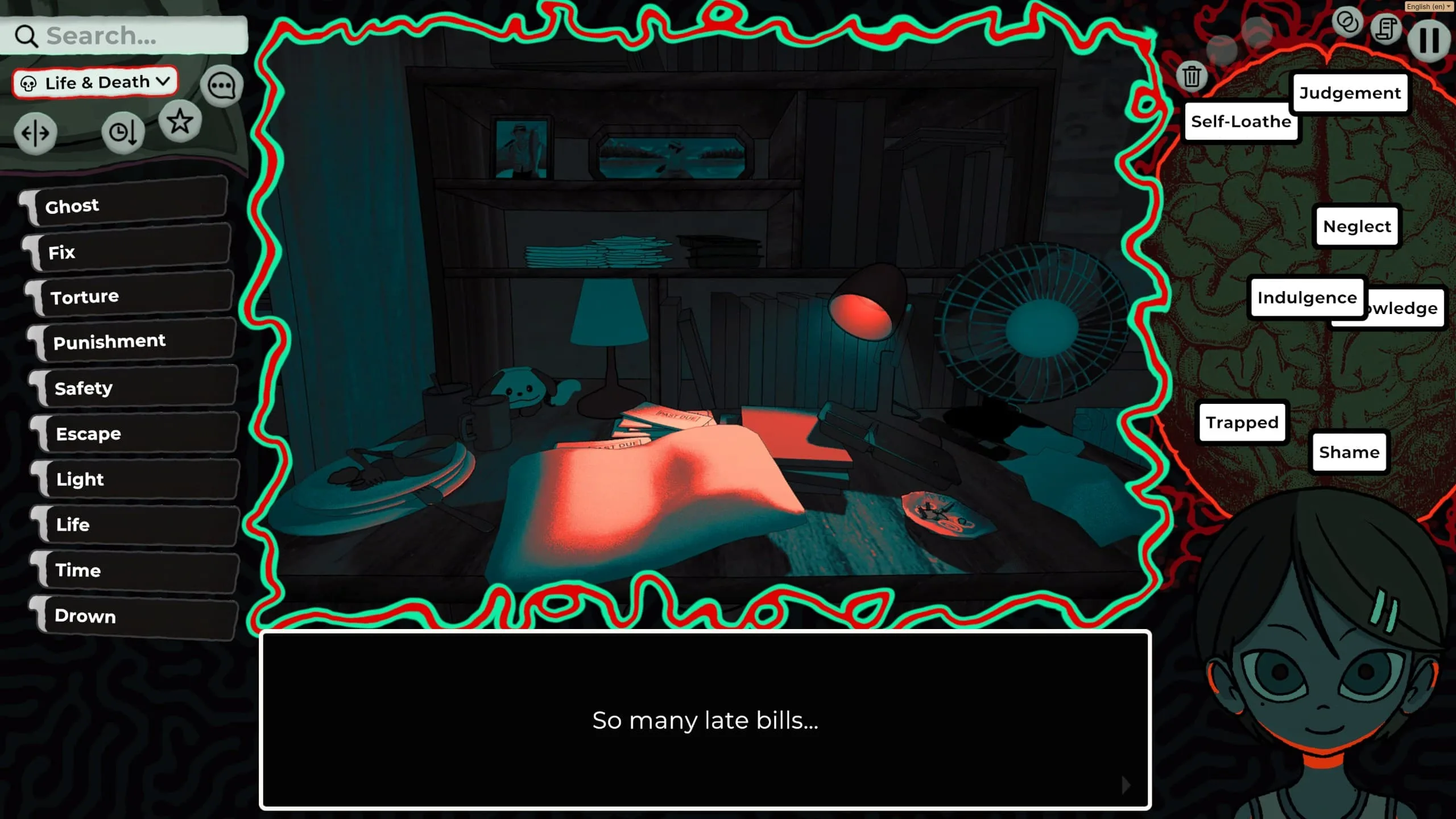
The short version: Am I Nima is not a game about finding the “correct” sentence. It is a game about building enough emotional vocabulary to make a choice you can live with. Rush the dialogue and you may survive the scene, but you will understand less of what just happened.
What you actually control
You do not control Nima’s movement in real time, and there is no combat system. You click objects in a series of fixed scenes, collect words, combine those words inside Nima’s mind, and drag a chosen word into conversation.
The word library is memory. The brain is a workbench. The dialogue box is the only place where a thought becomes an action. That three-part loop is the whole game in miniature.
The first words
The demo begins with two words: Nima and Stranger. Combining them creates Mom. Drag that word into the dialogue option to answer the woman across the room. When the game says words can be combined to unlock new words, that is not a hint about a hidden menu; it is the core verb.
Try to build a habit before you speak: return to the mind after each new piece of dialogue. New words can appear faster than the interface makes obvious. If you have an unused noun, test it against a person, an emotion and a place before you treat it as decoration.
Open the word library before each conversation. Look for new terms at the top and for words that belong to different emotional categories. A word that seems trivial in one context can become the missing half of a recipe in another.
How Mom’s tests work
Mom presents an object or asks a question. You answer with a word. She reacts. The demo goes out of its way to say there are no wrong answers, then makes it clear that there are. This is a characterisation choice, not a bug: she is testing obedience, memory and sincerity at the same time.
The demo is capable of ending your run when you push too hard. Some choices can end the demo early, and the closing sequence is a deliberately scripted narrative beat rather than a conventional “game over” screen you can easily optimise around. The full game is confirmed to have 13 endings, but HO! Games has not published the conditions for any of them.
Emotional recognition, attention to Mom’s wording, and words that fit the object in front of you.
Antagonism without a plan, treating every truth as safe to say, and ignoring what the room has told you.
Give you a clean combat solution. There is no weapon to find and no enemy health bar.
Explore before you speak
Nima’s bedroom is the demo’s main word engine. Books, trophies, plushies, a fish, a drawing and a locked locker all contribute to her vocabulary. The exploration is slide-based, not free movement, so “search everywhere” means clicking through every obvious object and revisiting a room when a new thought has changed your understanding of it.
You are not collecting trivia. Each object produces a word that may later serve as evidence, comfort or a provocation. Pay particular attention to objects connected to Nima’s father, swimming and the aquarium. Those subjects recur in the word web for a reason.
How to combine words well
Drag one word onto another inside the mind. Some pairs create a new word; some create several words; some do nothing. The demo’s UI will not tell you in advance which is which, so experimentation is the intended state.
- Start with people and emotions. Family combinations tend to produce narratively loaded results.
- Cross categories. A place plus an action, or a person plus an object, often works better than two synonyms.
- Revisit new words. A result is also an ingredient. The important recipes are chains, not one-off discoveries.
- Watch for multiple outputs. A single pairing can unlock more than one concept, so check your library after every combination.
- Use search and filters. By the bedroom section the list is large enough that scrolling will cost you attention. Search for the concept, not the exact word you expect.
Our Word Fusion Lab lists 10 demo-verified recipes and four community-reported ones. We keep those labels separate because a screenshot from a let’s-play is not the same evidence as a developer statement.
Five mistakes worth avoiding
1. Treating the first available answer as the safe answer
Mom’s approval is not a trust meter you can max out. Some answers make her calmer in the moment but leave Nima with less information. The game is interested in the cost of compliance.
2. Ignoring the secondary text
Nima’s thoughts sometimes arrive alongside the main narration. They can be petty, frightened or violent. They are not always the same voice as the one you are choosing to speak. Pay attention to what is not being said to Mom.
3. Hoarding words without testing them
A large library feels safe, but progression comes from making connections. Test likely pairs before a test scene, not during one. If a combination is going to fail, it is cheaper to learn that while no one is watching.
4. Assuming exploration is optional
The dialogue choices you need may be locked behind objects you did not inspect. The bedroom is not a collectible gallery; it is tomorrow’s script.
5. Expecting a conventional failure state
The demo’s final sequence is part of its narrative architecture. Do not assume that a complete run means you “won” every conversation. The full game’s 13 endings give choices more lasting weight, but those conditions are unconfirmed.
Whose thought is it?
Am I Nima is a horror game about unreliable narration from the inside. The person whose library you are building is not necessarily the only presence producing thoughts. The demo lets certain lines land with a colder, more strategic tone.
That ambiguity is not a puzzle you need to solve in chapter one. Treat it as evidence: when a thought seems out of character, notice which words accompanied it and whether it was ever spoken aloud. The character files separate demo evidence from fan theories about the second voice.
Saves and failure
The developer has said save/load is planned for the full release. The demo should not be treated as having a guaranteed save system. If you are experimenting with a long word web, give yourself enough time to finish the session.
For launch, the intended structure appears to be chapter-level progression with room for optional tests. HO! Games says there are more than 15 main tests, seven optional tests and 13 endings. We will document whether choices are reversible when the full game is available, rather than guessing now.
Accessibility and controls
The game is a point-and-click experience built around mouse dragging. Steam lists captions and English full audio. A 2025 preview reported interface alignment problems on Steam Deck at the time; current Deck compatibility and controller support have not been confirmed. The safer setup is a desktop or laptop with a mouse.
Content is intense: implied violence toward a child, eye mutilation, child neglect and imagery of bugs, spiders and worms. The horror is psychological, but the warning is not decorative. See the demo content section for more.
Starter checklist
Sources and verification
This guide is based on the public demo, the official Steam description, the September 5, 2026 development update and published hands-on impressions. We do not present a complete recipe list, because the full game is unreleased and the developer has not published one. Verification standards are explained in oureditorial policy.